What Is Actually Known About the Script Nobody agrees how many signs there are, and the disagreement spans a factor of four. That single unsettled number decides what kind of writing system this could be.
Set aside every proposed translation and a surprising amount is left. The direction of reading is established. Sentence boundaries are identifiable. Numbers have been located. None of that required knowing the language, and all of it survived being checked by somebody else. This page is what remains when the readings are removed, and it is the part of the subject that has actually made progress.
I. How Many Signs, and Why It Decides Everything
The size of a sign inventory is the most informative thing about a writing system before anything is read. An alphabet runs to a few dozen signs, because it encodes sounds and there are not many. A syllabary runs to the low hundreds. A system with many hundreds or thousands of signs is doing something else, most likely giving symbols to whole words.
For this manuscript the count is unsettled by an enormous margin. Kálmán Némäti, working between 1889 and 1892, catalogued about 792 distinct symbols and observed that this is roughly ten times the size of any known alphabet. Other treatments work with figures in the low hundreds. The published range spans a factor of four or more.
The disagreement is not carelessness and it will not be settled by counting more carefully. When two marks differ slightly there is no way to tell from the marks alone whether they are two signs, or one sign written twice by a hand that varies. Split generously and you get a large inventory and a word-based system. Merge generously and you get a small one and something closer to a syllabary. The choice is made before the analysis and it determines the analysis.
Némäti drew the right inference from his own count in 1892: whatever this is, it is probably not an alphabet. A hundred and twenty-six years later, Tokai and Király's conclusion that small groups of signs stand for whole words is the same shape of answer, reached by a completely different route. That is what a durable result looks like.
This is not a Rohonc peculiarity. The dispute over whether the Indus script is logosyllabic turns mainly on its inventory size, and that number is unsettled for the same reason: nobody can say from the marks alone which variants are the same sign. Any claim about what a script is, made before its inventory is settled, is standing on the count.
II. What Has Held
Four things about the writing have been established and independently confirmed. All four were found without knowing what the text says, which is why they survived and the translations did not.
| Property | Established by | Confirmed by |
|---|---|---|
| Runs right to left, top to bottom, pages right to left | Gyürk, 1970 | Locsmándi, 1990s. Consistent with the lines being justified against the right margin |
| A symbol acts as a sentence delimiter | Locsmándi, 1990s | Király's sentence segmentation, 2011 |
| Number-like patterns, later a system using powers of ten | Gyürk, 1970 | Tokai and Király, 2010 onward |
| No case endings, which argues against Hungarian | Locsmándi, 1990s | Consistent with a code that does not represent word structure |
The last of those deserves a note. Hungarian is heavily inflected, so if the underlying language were Hungarian written in an unusual script you would expect recurring endings all over the text. Their absence is evidence, and it is evidence against the reading most people would reach for first, given where the book was found and what its nineteenth-century champions wanted it to be.
III. The Numbers Were the Way In
With no bilingual and no known language, a decipherer needs something in the text whose value can be guessed from outside it. In this manuscript that turned out to be the numbers.
Gyürk spotted number-like behaviour in 1970. Locsmándi found that one symbol seemed to work both as a delimiter and as a value. Tokai then found four-digit numbers positioned like years, counted not from the birth of Christ but from the creation of the world, which was a perfectly ordinary way to date things in this period. Once you suspect a year, you have a testable guess: the numbers around a nativity scene should differ from the numbers around a crucifixion by about the length of a life.
Tokai and Király's number system uses dedicated symbols for powers of ten. It is also the part of their work that has drawn the most doubt, on the grounds that the system they describe has no historical precedent and the equivalences are suggestive rather than forced. That objection is live and unresolved.
The general point survives it. A number is the only thing in an unreadable text whose meaning can be constrained from the outside, which is why numbers keep appearing at the start of successful decipherments and never appear at the start of failed ones.
IV. The Book Has Been Disturbed
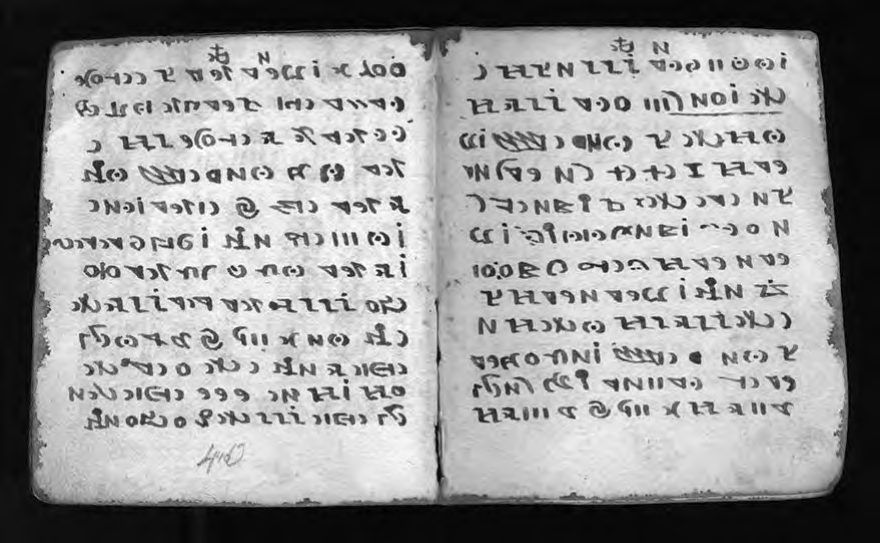
Tokai and Király record that bifolios are missing, that leaves have been swapped and reordered, and that a later foliation misleads rather than helps.
It matters more than it sounds. Any statistical claim about a text assumes you know what order it goes in. If the leaves are out of sequence, a measurement that spans a page boundary is measuring an accident of rebinding rather than anything the scribe did. It is one more reason a transcription of this manuscript needs its codicology attached, and one more reason it is unfortunate that the higher-resolution photography covers eight pages rather than 448.